



Most executives know they should “be on LinkedIn” but it isn’t clear what that actually means. Is it enough to have a profile? Do you need to post, and if so, how often?
Turning to LinkedIn experts for advice doesn’t help, mainly because most of them are speaking to small business owners, consultants, and freelancers – not to executives.
The whole thing feels like a lot of effort, and you might feel like it isn’t clear what the payoff would be.
Let’s break it down here.
First, there is no one correct way for executives to show up on LinkedIn.
How an executive uses LinkedIn should change as their career stage, goals, and leadership focus change. What serves a newly promoted leader trying to establish credibility is not what serves a board-ready executive shaping industry conversations.
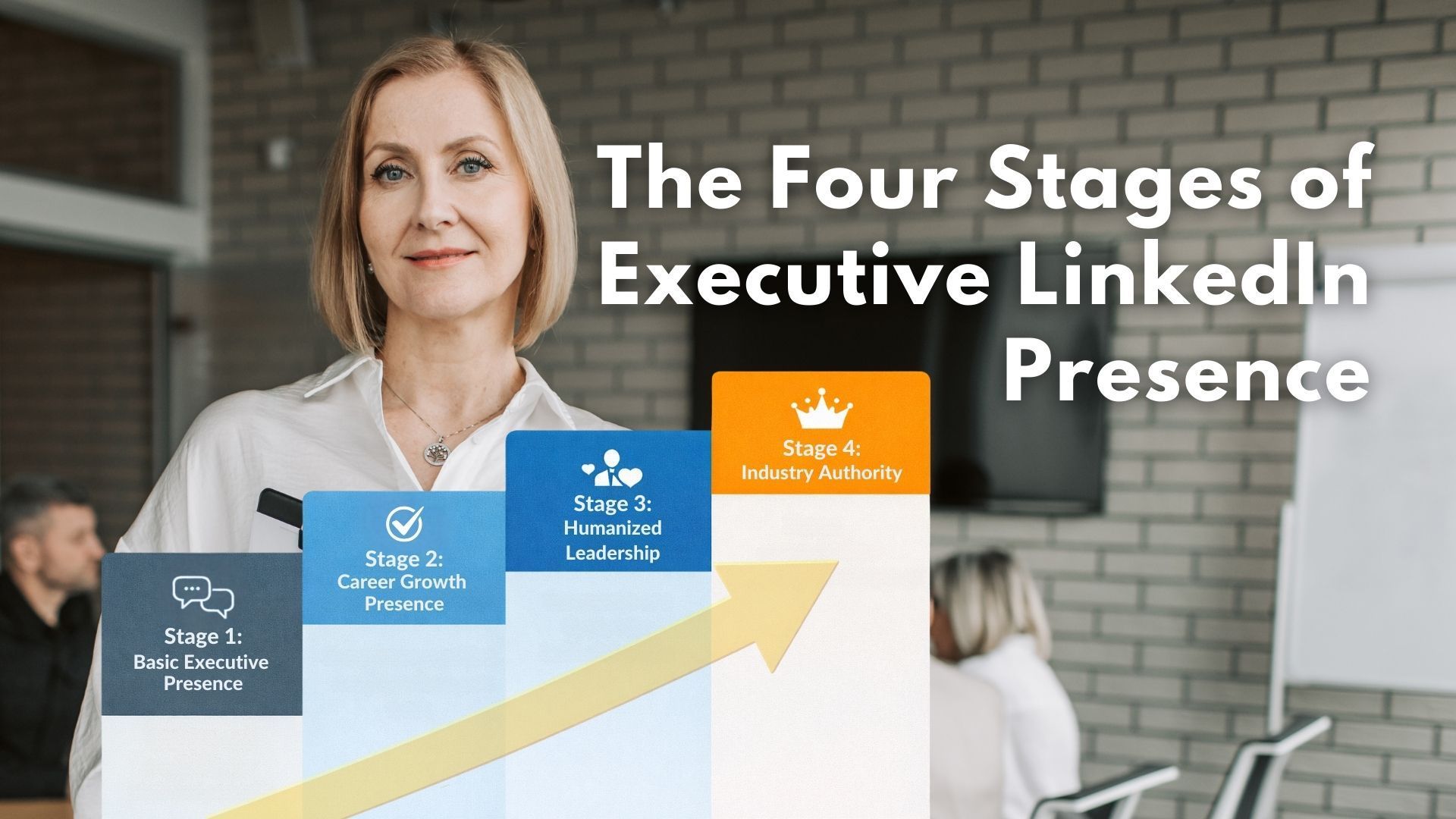
Here is how I think about the four stages of executive presence and how to determine which one fits you right now.
- Executives should evolve their LinkedIn presence with their career stage, leadership goals, and visibility needs.
- Stage 1 is about showing that you’re a successful leader inside a well-run company.
- Stage 2 shows people how you think, ideal for attracting new opportunities and board roles.
- Stage 3 humanizes you and builds trust by showing the person behind the title.
- Stage 4 is about growing your influence, shaping industry conversations and expanding your impact.
Stage 1: Basic Executive Presence
Stability and credibility for your current role
When you are in a stable role, your primary objective is simple: be visible as a capable, credible leader inside a healthy organization.
You are not trying to differentiate yourself per se. You are reinforcing confidence in your role, your team, and your company.
Your content at this level is straightforward:
- Repost company announcements with a short comment
- Highlight team accomplishments
- Congratulate partners and customers
- Share hiring opportunities, both for your team and from your network
These posts are designed to show stability and build goodwill. The message your audience receives is clear and reassuring: this is a competent executive operating inside a well-run organization.
At this stage, your energy should be spent executing your job well, not building a personal leadership narrative.
Questions to ask yourself:
- Is it more important to succeed in my current role than prepare for new opportunities?
- Do I want consistent visibility without emotional exposure or time pressure?
- Am I more comfortable amplifying company activity than directing attention toward myself?
Stage 2: Career Growth Presence
Show how you think, not just where you work
This stage begins when your goals expand beyond your current role.
You might be quietly interested in a promotion, a move to another company, or your first board role. You may want recruiters, senior leaders, or peers to see more than your resume. You want people to understand how you think as a leader.
Basic presence alone no longer accomplishes that. At Stage 2, your visibility shifts from sharing news to offering insights. At this level, you add short posts that reflect real leadership experiences:
- Commentary on industry or business news
- Insights from talking to customers or partners
- Your perspective on market trends
- Lessons from hiring or team building
These are practical posts. You do not have to get vulnerable. The goal is not to become a public thought leader. Your goal is clarity: let people see the quality of your thinking.
This stage creates a different leadership signal. Instead of only seeing your role, audiences begin to see your potential. Recruiters and peers start to recognize that you already think at the next level.
Questions to ask yourself:
- Do I want people to understand how I approach leadership decisions?
- Am I positioning for promotion or new opportunities, even quietly?
- What cadence of sharing reflections feels sustainable for me?
Stage 3: Human Leadership
Let people see the leader behind the title
This stage is often misunderstood. It is not about vulnerability for effect or making LinkedIn personal for the sake of it. It is about building trust through authenticity.
Executives step into this stage when human connection matters as much as visibility. This often occurs when:
- Companies are growing rapidly and culture must be intentionally protected.
- Leaders want stronger loyalty and engagement from their teams.
- Executives realize they are seen more as a title than as a person.
- Trust begins to matter as deeply as authority.
At this level, your content should include occasional short reflections that explore topics such as:
- Your leadership values and philosophy
- What you are learning from books, podcasts, or personal mentors
- Cultural standards you hold your teams to
- Lessons from meaningful leadership challenges
- Personal causes you care about and support
Your tone should be personal but always professional. You don’t need to go deep or overshare. The goal is showing character rather than private details.
This stage humanizes you. It signals emotional intelligence and integrity. It allows people to follow you not simply because of your role, but because they trust the kind of leader you are.
This is particularly useful in a large company, where everyone who reports up to you doesn’t get to spend time with you. Or when you are hiring and you want job candidates who fit your culture. It helps people feel aligned before they ever meet you.
Questions to ask yourself:
- Do I worry that people see me as a position rather than a person?
- Am I actively shaping culture and values at scale?
- Would I feel comfortable sharing well-curated leadership stories from my own experience?
- Is building trust as important as building visibility for me right now?
Stage 4: Industry Authority
Shape conversations beyond your company
Not every executive needs or wants this stage, and that is perfectly fine.
This level is for leaders who aim to shape thinking across industries. These are CEOs, founders, board candidates building portfolios, and late-career executives seeking broader impact. Here, the focus moves outward:
- Develop original leadership or industry frameworks
- Publish longer content or newsletters
- Participate in podcasts, panels, and speaking engagements
- Offer public commentary on workforce trends, ethics, innovation, or global business shifts
This stage establishes true authority. It communicates that you are not only advancing a company but influencing an ecosystem. You are signaling that you are a leader who shapes conversations.
Questions to ask yourself:
- Do I want influence beyond the boundaries of my company?
- Am I ready to take visible positions on industry issues?
- Do I enjoy developing ideas and sharing them publicly?
- Is building a long-term leadership platform part of my next chapter?
Your Stage Should Match Your Season
The most important thing to understand is this: there is no fixed destination.
Executives move through these stages over time, and many move forward or backward as circumstances change:
- A new role may call for Stage 1 stability.
- Career ambitions may activate Stage 2 perspective.
- Leadership evolution often invites Stage 3 human connection.
- Industry prominence may lead to Stage 4 authority.
The mistake many executives make is trying to skip stages or forcing themselves into a presence that does not align with where they actually are. The most effective visibility strategy is choosing the level that serves you now, knowing that where you want to go next may shift in the years ahead.
A thoughtful LinkedIn presence should feel aligned, not uncomfortable. When it does, it becomes something that works for your career rather than another obligation competing for your attention.