



Did you hear the story about the company where everyone had worked hard and well, systems were in place, teams were aligned, and the opportunity for big new business was just ahead?
All they needed was a couple of key hires.
But finding the right people was taking so . . . so . . . so . . . long.
Hiring the right people is a magical combination of art and skill that starts with attracting those folks. And candidates today want to know everything they can about a company before they even step in for an interview.
They check out your company’s LinkedIn page. They look at your website. They look at Glassdoor. They look to see who else works there.
And they also look at your profile, as the CEO, and the hiring manager’s profile too.
That is where many companies miss an opportunity.
You may already be investing in employer branding. You may have videos about what employees love about your culture. You may post about company volunteer activities. You may welcome new employees on social media.
All of that helps. But job seekers also want to see for themselves who your executives are, how they think, how they manage, and how they interact with employees.
When you make the strengths and vision of your CEO and executive team visible on LinkedIn, you can make your company look like a more attractive place to work. You can help candidates understand the opportunity before they apply. And you can give your company a significant advantage in hiring.
Key Takeaways:
- Executive visibility might be your recruiting advantage as candidates research a CEO before they apply. They check the company page, then look at the CEO and hiring manager profiles to judge who they would work for.
- Strong candidates want to know whether the CEO they could be working for is trustworthy, respected, and the kind of leader worth reporting to. A LinkedIn profile answers those questions before a recruiter ever reaches out.
- A visible leadership team makes the whole company look stronger. When candidates see that the CEO and other executives lead publicly, the company reads as more stable and credible.
People care about who they work for
As the CEO, your personal brand matters because people care about who they work for.
You are the public face of your company. You set the tone. You are typically the most visible person in your firm, and when a job candidate researches your business, they are very likely to look at you.
Think about what happens next. If they Google you, what will they find? Does what they discover sell you and your business as strongly as it could?
If they look for you on LinkedIn, what will they see? Will they get a sense of your leadership, your vision, your values, and the kind of company you are building?
When recruiting is a priority, setting up a social media presence that appeals to ideal candidates is a strategic move.
This is especially important when you are hiring senior leaders, sales executives, engineers, developers, or other technical team members. These candidates are looking carefully at the company, but they are also looking at the people they would work for. They want to know:
- Are you trustworthy?
- Are you smart, innovative, and respected?
- Do you care about your team?
- Do you give people room to lead?
- Would joining your company be good for their career?
LinkedIn lets you answer those questions proactively, before you even know they might be interested in the role.
Show why your company is an exciting place to work
Let’s start with the basics. You want your LinkedIn profile to tell the story of what you do and why you believe it matters.
Talk about the problems you can solve, who you solve them for, and how you solve them.
Share your traction, so people can see your business is growing. You may have well-known clients, strong investors, awards, user volume, revenue growth, or important milestones. Everyone wants to work for a company that is successful in its industry.
A rapidly growing business is a dynamic and exciting place to work. Employees work on interesting projects, have greater opportunities for promotion, and can look forward to possible participation in an exit.
Make the vision clear.
People should be able to see that they can take an exciting journey with a mission-driven business. They will be challenged. They will work with new technology. They will add useful skills, make powerful connections, and gain accomplishments that enhance their resume and open doors for the future.
This is the story prospective employees want to hear. It is also the story prospects, partners, investors, and the media want to hear.
Your company page can tell part of that story. Your LinkedIn profile can reinforce it by telling the story in your own words.
When the company posts, share the post with a comment. Use your comment to bring the focus back to your mission. Share your own company stories, both about customers and employees. Use personal stories to show that you live the mission.
The more consistently candidates see that story, the more real it becomes.
Let your passion come through
Include your founding story. I bet it’s a good one.
If you’re not a founder, someone with your background and experience could be doing a lot of different things. Why are you leading this company?
Let your passion come through. And although you might not think of it as passion, you do have passion for what you do or who you do it for. Being a CEO is too hard. You don’t do it unless you have a fire in your belly. What fuels your fire?
One of the things I like to do when I’m working with a CEO is listen for what they are passionate about.
For some, it’s the problem they solve. They are endlessly fascinated by that problem, and if they sell their current business, they will start another that addresses the same problem in a different way.
Some are in love with their solution. They have developed an amazing solution, and if they start another business, they will build something similar, maybe a little better this time, and apply it in a different market.
Others are in love with their customers. If they started another business, they would find another problem they can solve for this same group of people.
Some CEOs are in love with their team. If they sell, they will start another business and bring the whole team over.
Some are in love with the processes and systems they have developed, and some with the technology they use.
Most company leaders are in “like” with many aspects of what they do and passionate about one or two.
Wherever your passion is, make it visible. You’ll attract other people who bring that same level of energy to your company.
Share your management style
Once you’ve discussed what you do and why, tell the story of you as a leader.
Most CEOs are deeply intentional about their management style and their leadership philosophy. When you share those principles, you attract people who want to be managed that way and want to be led by someone like you.
You can describe your style simply or go more in-depth with a blog post or video. Either way, put it on your LinkedIn profile, where people can find it.
Candidates want to know how decisions get made. They want to know how quickly the organization moves, how much autonomy leaders have, how dissent is handled, and how the company thinks about accountability.
Senior candidates pay close attention to how you talk about your leadership team. Do you share credit? Do you demonstrate trust in the people you have hired? Do you show that you are building leaders around you?
They also watch how you communicate about hard moments. Strong candidates know challenges exist. They want to see accountability, steadiness, and thoughtful reflection.
When you communicate with clarity and responsibility, it is easier for candidates to trust you.
Make your leadership team visible too
The CEO sets the tone for the entire company, but candidates also look at the leaders closest to the role.
- If you are scaling hiring in sales, the leadership brand of your Chief Growth Officer or VP of Sales matters too.
- If you are hiring engineers, consider the brand of your Chief Technology Officer or head of R&D.
- If you are hiring in finance, marketing, operations, or customer success, candidates will look at those executives too.
Give each executive, especially those who are hiring, a LinkedIn profile that showcases their personality. Have them talk about their why, their vision for their team, and the journey they traveled to arrive where they are today.
You can tell stories in blog posts where the executive talks about their management philosophy. Are they a servant leader? A Stoic? A systems thinker? A customer advocate? A builder?
With LinkedIn updates, you can provide insights into a day in the life for that executive.
When candidates see a strong leadership bench, the company looks stronger. It looks more stable, more credible, and like a place where capable people have chosen to work.
Strong talent attracts strong talent.
Help candidates experience your culture
You have built your culture intentionally, designed to attract and support the type of high-caliber employees you want.
Make that culture visible. Show prospective employees what it is like to work for your business.
When you showcase your culture, you attract the type of people who want to work in that environment. And, even more importantly, you allow people who are not a fit to go away without wasting your time.
But successfully talking about culture on social media requires you to walk the talk. You must authentically reflect what really happens in your company, not what you think people want to hear or an idealized version of what you wish the culture was.
Share stories that show the company’s values and the way they are brought to life in day-to-day work.
Post regularly about what’s happening inside the company: new projects, collaborations, customer success stories, and team moments. Tag the employees involved and let their stories come through. Candidates trust employees far more than marketing copy.
Share stories from employees who work in implementation or support, and how they contribute to the company’s success.
Know your employees well enough to publicly celebrate their individual professional wins, when appropriate. Did your company invest in someone’s continuing education and now they are graduating? Did someone just earn an important certification?
And share the fun stuff too. Celebrations, outings, sports, staff lunches, and Zoom get-togethers all help tell the world what working for your company is like.
Usually, the culture will have been guided by you, but it really arises and takes on a life of its own as the team co-creates it.
Your culture might be that everyone stops work at 5pm Friday and you bring in pizza and beer. Maybe you go hiking together or do Habitat for Humanity. It might be that every Wednesday you have yoga in the office. It might be that people can bring their dogs to work.
Tell those stories in blog posts. Use photos to show your team in action. Take videos of employees talking about what they like best about working for your company.
The point is that your company is different, and you have created that culture intentionally. Make that visible.
Talk about operations, flexibility, and how work gets done
You can showcase your operations on LinkedIn by posting content that provides insight into your processes, products, and services without divulging any competitive advantages.
- Share videos or images that demonstrate how the company’s products work and the benefits they deliver.
- Highlight the company’s unique processes, methodology, and innovations.
- Post behind-the-scenes looks at the company’s offices or your remote-first culture.
You can’t talk about hiring without discussing the location options: in-office, remote, hybrid, and all the variations. It is part of your company culture, but it is so much more these days.
How flexible is your company when it comes to where and when people work? If you have a bricks-and-mortar building, what is it like to be there? Do you have great amenities? If your team is remote, how do you support remote workers and keep them connected?
Job candidates want to know as much as they can before they say yes or no, so build a LinkedIn presence that showcases work life at your company.
If your team is working at the office, post photos and videos of employees enjoying the office amenities, such as ergonomic workspaces, wellness rooms, and recreational areas.
If your team is remote or hybrid, highlight the tools, norms, and resources that help people work well together. Share stories from employees about how flexible policies have positively impacted their work-life balance.
These details matter because candidates are trying to picture themselves inside the company. Make that easier for them.
Show executives communicating
When executives are active on LinkedIn, it shows that they know how to leverage social media to communicate. They look current and relevant.
Job candidates can see that your leaders are able to meet employees where they are and communicate in an open and transparent way.
Social engagement also shows that your executives are accessible, open to feedback, and able to deal with the real world without hiding behind layers of corporate bureaucracy.
Executives do not need to post daily to accomplish this. Once a week or even once a month can be sufficient.
They can share something they’ve learned. They can comment on a team win. They can celebrate a product milestone. They can add a thoughtful comment when the company posts. They can recognize an employee who earned a promotion, won an award, completed a certification, or did an especially good job.
These actions may seem small, but they create visible proof of culture.
When leaders engage with employee posts, people see that your team interacts in a genuine, positive way. That warmth and connection can be felt immediately, even by someone who has never met you.
A vibrant comments section communicates that your company is thriving, collaborative, and connected. It is the difference between a static LinkedIn presence and one that makes candidates feel, “I want to be part of that.”
Walk the talk
Your company may have diversity and inclusion initiatives. You might be trying to hire more female engineers or increase racial diversity across the company.
To attract top candidates, you need to show that you believe in diversity, have a diverse team or are working to improve diversity, and have programs in place to ensure equity and inclusion.
When executives interact with diverse leaders, peers, and employees in social media, it shows that DEI goals aren’t just on paper. They are lived out by people who make decisions in the company.
More candidates also want to work for a business that takes some level of responsibility for its impact in the world. You are never going to be aligned with everyone on everything, but if there is a cause that matters to you as a company, that story should be easy to find.
Leaders who sleep out for homelessness or live sustainably show their commitment to social responsibility. Executives who demonstrate work-life balance attract employees who want a healthy workplace.
Employees and prospective employees see this engagement and culture. They know whether they can thrive in your environment, and whether this is a boss who supports them.
Use LinkedIn before you need to hire
When you are strategic about building a strong employer brand, you allow people to educate themselves about you and your business before they apply for a job or interview.
The people who are a good fit will get excited about the opportunity.
When you talk to them, you’ll spend less time selling them and more time engaged in a rich conversation about the job.
This is the advantage of making leadership visible before you have an urgent hiring need.
By the time a recruiter reaches out, a candidate may already know what your company does, why it matters, who leads it, what the culture feels like, and why this could be a good move.
That changes the conversation. It makes the company feel more familiar. It makes the opportunity feel more credible. It gives strong candidates reasons to lean in.
Before your next hiring push
Before your next hiring cycle, take a few minutes to look at your team’s LinkedIn presence:
- Does your profile make the company look current, credible, and exciting?
- Do your posts tell a consistent story about your company’s mission and energy?
- Are you making your company’s culture visible?
- Do executive profiles show leadership strength, or do they read like short resumes?
- Can candidates understand what kind of boss they would be working for?
If not, now is the right time to make those updates. Use this formula to plan your strategy:
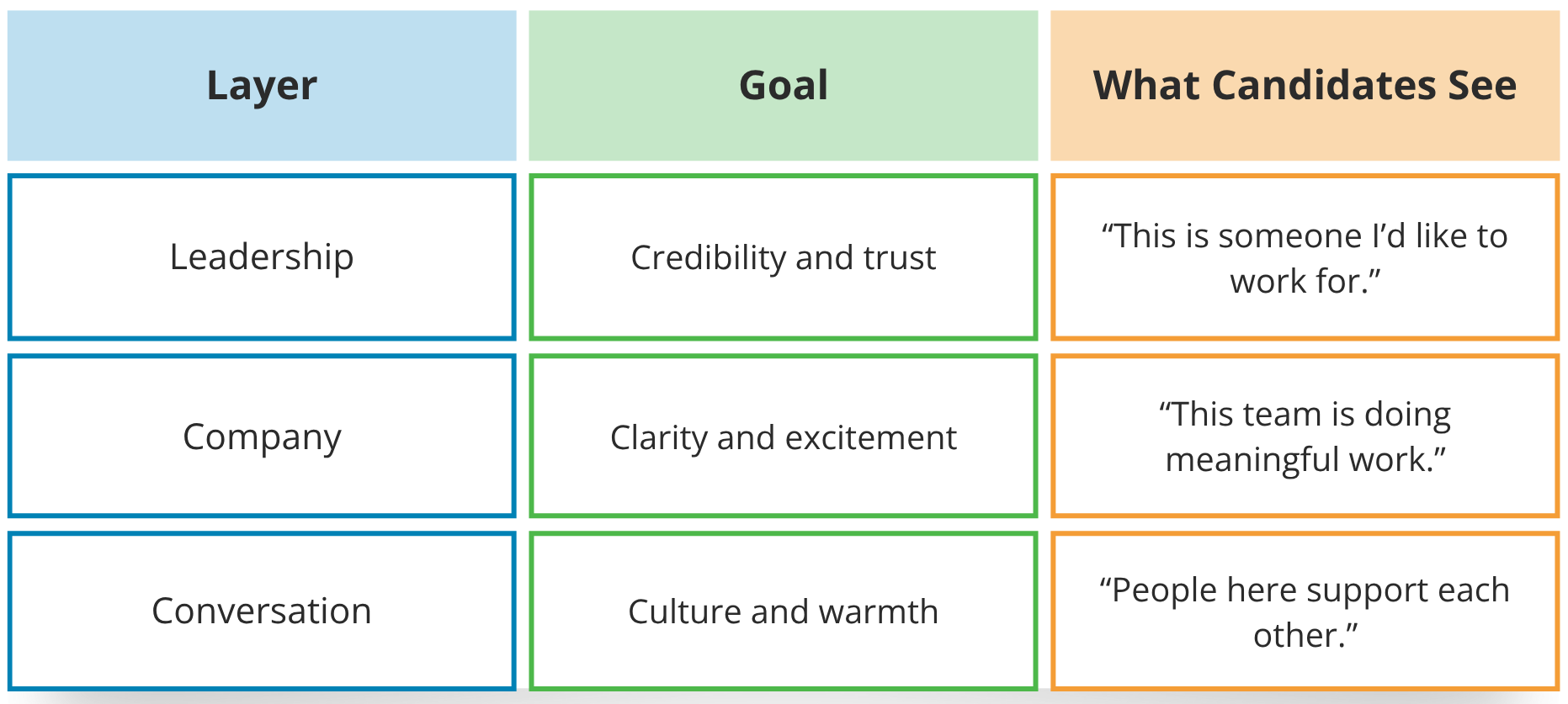
Invest in transparent leadership
LinkedIn is the go-to destination for job seekers, and for good reason. Make its many features work for you.
Your executives are amazing people. They are thought leaders, builders, problem solvers, and hard-working leaders with ideas worth sharing.
When you make their strengths and vision visible on LinkedIn, you are able to use their star power to attract more people like them.
The very best people, the ones who will make the biggest difference to your company, are not only superstars in their role. They want to be managed by someone who manages like you do, and they want to work in a company that has the kind of culture you have created.
When you allow people to see who you are as a leader and what your company culture is, you attract the people who will thrive in your business and have a huge impact.
That is how your CEO and executive team can become one of your strongest competitive advantages in recruiting.
Check out our other blog posts and resources for recruiting and hiring:
Growth-stage CEOs: How to Hack Recruiting (video course, 10 min)
Series B CEOs: What Top VP Candidates Want to See from You
How Smaller Tech Firms Can Attract Top Talent from Tech Giants
How to Make Your Team Look Aligned on LinkedIn
5 Essential Stories for Your Employer Brand
LinkedIn Recruiting Strategy: Build a Talent Pool
5 Ways to Show Support for Diversity
How to Show Sustainability Matters to You
LinkedIn Checklist: Employer Brand (pdf)