



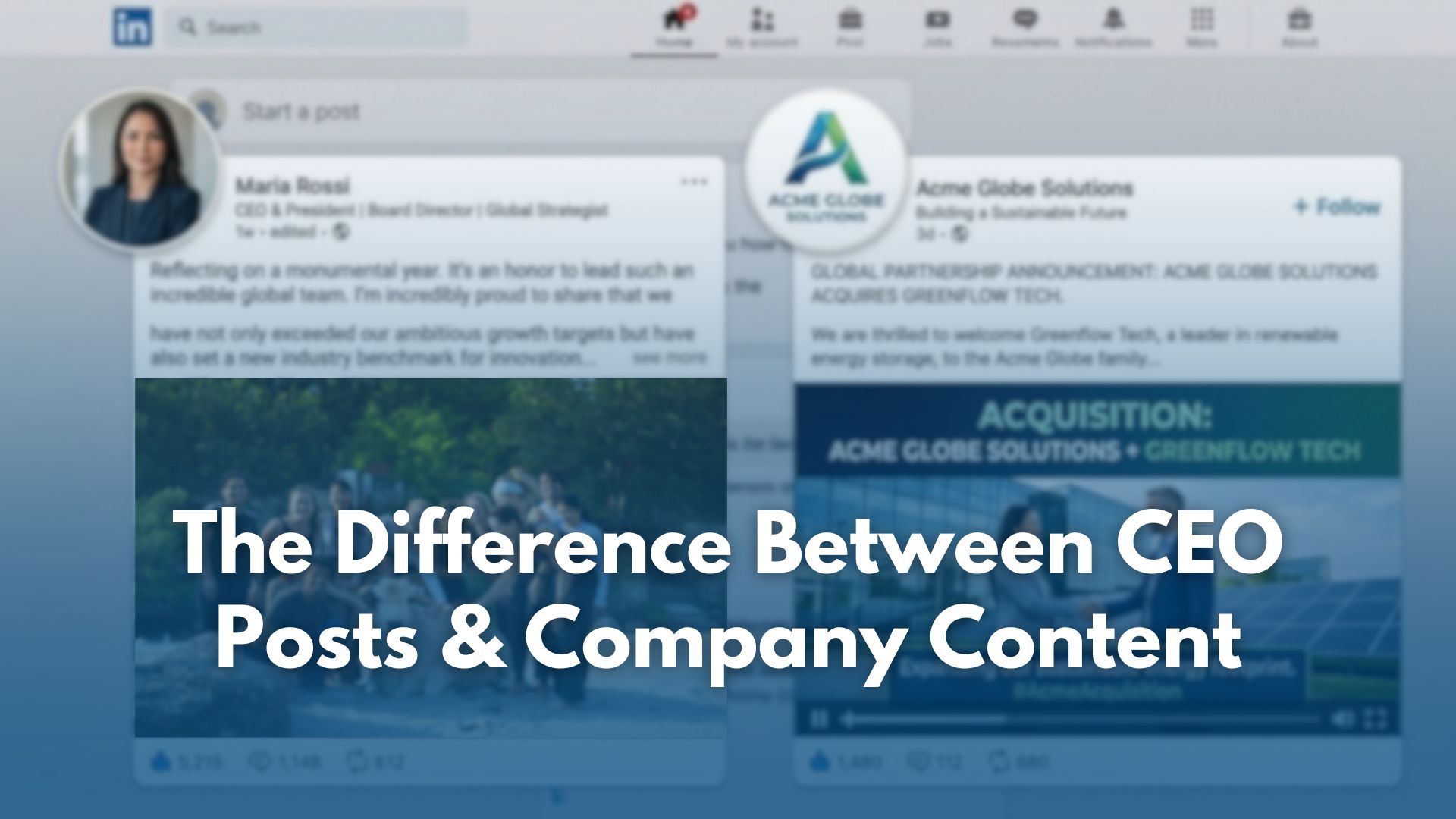
“Our company already has a strong presence on LinkedIn. Why can’t I just repost things from the company page?”
I hear some version of that fairly often.
My answer is that you should definitely repost. First, you do want alignment between the CEO’s content and the company’s content, and reposting is an easy way to get that.
Plus, the CEO often has a larger and more impressive following than the company page, and you definitely want the company’s posts to reach their audience.
But if all a CEO does is repost, they’re missing an opportunity.
The company page already tells people what the company is doing. The CEO should interpret the news, provide context, and add depth.
Key Takeaways:
- Reposting company content is a good start, but if that’s all a CEO does, they’re missing the opportunity. The company page says what the company is doing. The CEO’s job is to interpret it, add context, and show the thinking behind it.
- A company page talks about products. A CEO has room to talk about the problem, a shift in the market, or something buyers haven’t noticed yet, which gives people a reason to follow and learn.
- The CEO can share things a company page can’t. First-hand lessons from hundreds of customer conversations, how their thinking changed, and candid informal takes deepen and enrich company messaging.
- Use company news as a starting point, not the whole post. When the company announces a partnership, explain why it matters. When a product launches, talk about the customer problem behind it.
1. Explain why the news matters
A company announcement usually focuses on the news itself. A product launched. A partnership was signed. A new executive joined. The company raised money, opened an office, published research, or landed an important customer.
The CEO can make that news more meaningful by explaining what led to it. Why was this the right move? Why now? What were customers asking for? What changed in the market? What did the leadership team see that made the decision worth making?
That kind of context is much more interesting than simply repeating the announcement.
2. Spend more time on the problem than the product
Company pages naturally need to talk about what the company sells. CEOs have more room to step back and talk about the market.
They can discuss a problem customers are struggling with, a change in buyer behavior, a shift in the industry, or an issue companies have not noticed yet.
This gives people a reason to follow the CEO even if they are not currently looking for the company’s product. In fact, the CEO can get into a buyer’s head early enough to frame the problem for them, making their solution the only logical choice.
3. Show people how you think
LinkedIn is one of the few places where you can go to learn how someone thinks.
Your thinking is a big part of your company’s competitive advantage. Make some of your thinking visible and you’ll find that becomes a way to advance your business strategically.
Maybe you share how customer conversations changed your product’s development. Maybe you made an assumption that turned out to be wrong. Maybe you chose one strategy over another because you noticed something no one else saw.
When you create transparency into your thought processes, you build trust and attract people who appreciate your approach to growing a business.
4. Draw on what you have seen first-hand
The company can say that it has worked with hundreds or thousands of customers. The CEO can talk about what that experience has taught you.
After enough conversations with customers, you see the mistakes companies make repeatedly, the things they underestimate, and the decisions that tend to produce better results.
That accumulated experience is valuable. It is one of the things a CEO can contribute that no marketing team can come up with.
5. Be more candid than the company can be
A company page has to speak for the entire organization, which naturally puts some limits on tone and subject matter. A CEO can be more open.
You can speak in an informal way, do videos on your phone, show your enthusiasm.
You, as a human, are always going to be more interesting than a business.
6. Participate in the conversation
A strong CEO presence is not just about posting. Some of the most valuable activity on LinkedIn happens in the comments.
When a customer, partner, employee, investor, analyst, or industry leader raises an interesting point, the CEO can engage directly. That creates opportunities to add perspective, ask questions, recognize good work, and build relationships.
Company pages can engage too, but the interaction feels different when it comes from the CEO.
7. Talk about things outside your company
If every CEO post is tied directly to a company announcement, the content will become repetitive very quickly.
CEOs can also comment on changes in the industry, shifts in customer behavior, leadership challenges, hiring, technology, regulation, business models, or lessons they have learned while building the company.
Those topics contribute to the company’s reputation because they show the quality of the thinking behind the business.
Use company content as a starting point<
There is nothing wrong with sharing company news. The key is to add something.
- When the company announces a partnership, the CEO can explain why the relationship is important.
- When a new product launches, the CEO can talk about the customer problem that led to it.
- When the company publishes research, the CEO can discuss the data they found most interesting and what it means.
The company page and the CEO’s presence should support each other, but they should not be identical. The company communicates what the organization is doing. The CEO enriches that information by helping people understand the thinking, experience, and judgment behind it.
Need help crafting your own unique presence? Let’s talk!