



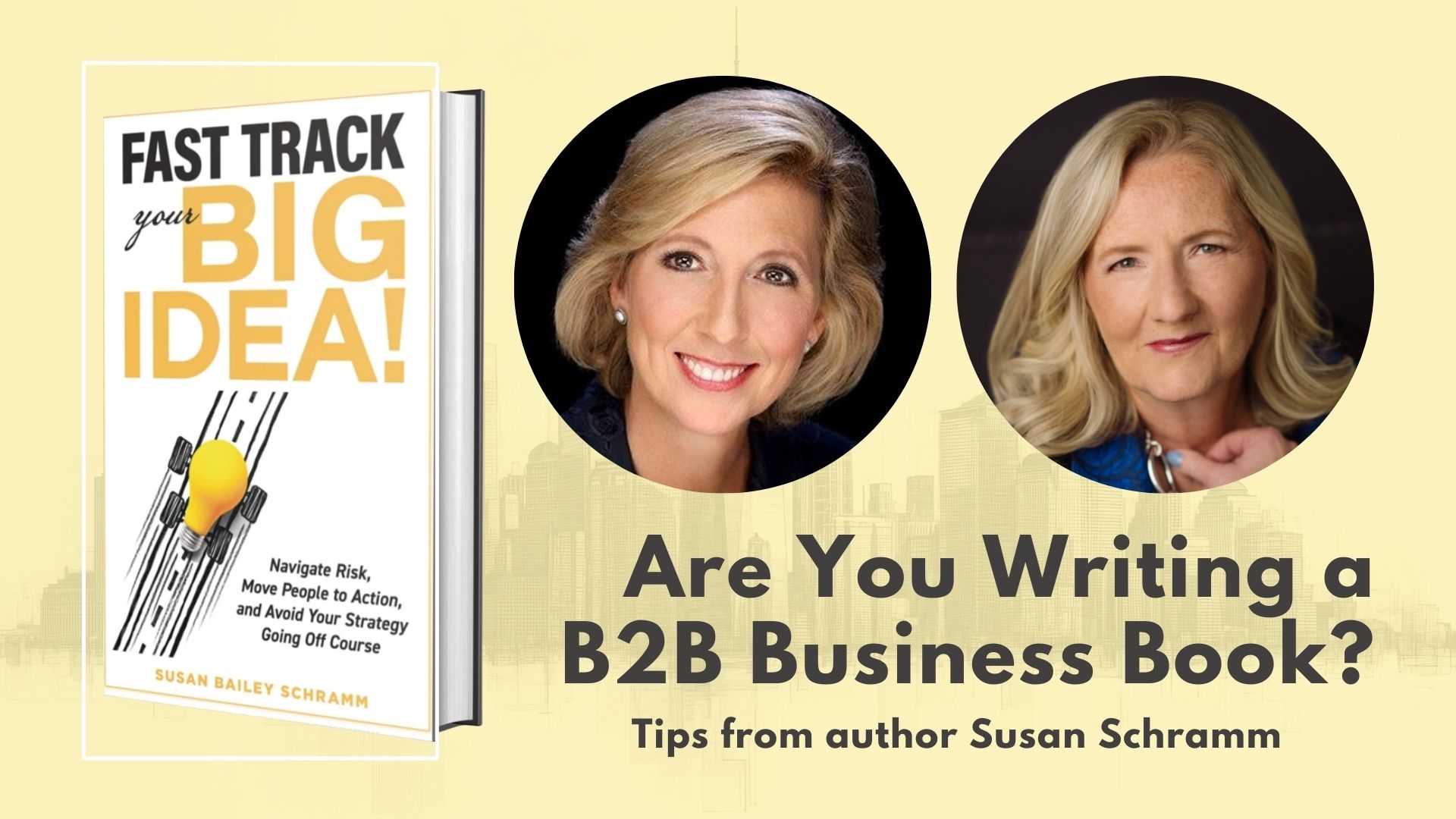
Insights from my conversation with author and strategy expert, Susan Schramm
Is writing a business book one of your goals for the coming year?
Executives are writing books at an accelerating pace. Some want to share a framework they have developed. Others want to provide insight into a challenging situation or advocate for a new way of looking at the world. Still others use a book to build credibility, attract opportunities, and create an on-ramp to deeper engagements.
Writing a book is a substantial undertaking, one that requires a significant commitment of time and resources. But the benefits of contributing your knowledge to your industry are well worth the effort.
We have worked with quite a few authors as they have gone through the process of writing their book, launching it, and publicizing it. It’s always fascinating.
I recently watched Susan Schramm launch her new book, Fast Track Your Big Idea Navigate Risk, Move People to Action, and Avoid Your Strategy Going Off Course.
Her work highlights the often-overlooked “people side of risk” – how assumptions, misalignment, and hesitation can quietly derail even the strongest strategies.
Susan is someone I have known for years (not a client or a relation, despite having the same last name), but I was so impressed with the way she handled her book launch that I asked if I could interview her to get some tips.
Here’s what she shared with me.
Key Takeaways:
- Writing a B2B book works best when it aligns with your business goals and reflects your unique leadership lens.
-
Your LinkedIn presence can help refine your book ideas, attract a publisher, and build early buzz.
-
Testing content on LinkedIn reveals what resonates and helps you write a stronger, more relevant book.
-
A thoughtful book launch strategy activates your network, builds visibility, and strengthens relationships.
Start With the Big Idea
Many executives make the book the goal. Susan made impact her goal.
She told me, “The book is called Fast Track Your Big Idea!…Move People to Action… So you can imagine that moving people to action is something I actually better get right.” Her focus from the beginning was clear. She wanted to:
- “Help leaders who have a big idea that matters, but feel frustrated that it’s not moving fast enough.”
- Give people a framework to de-risk, align, communicate, and adapt their strategies using her Acceleration Advantage ™ flywheel.
- Reach people she can’t serve one-on-one.
She was intentional about embedding her approach into every part of the book. “My brand is all about tangible next steps,” she told me. “The book is very strategic, but it’s about taking strategic actions. It’s very much about ‘doing something.’”
Position the Book Inside Your Business Strategy
For executives, your book should support how you sell, teach, lead, speak, or advise. This is particularly important if you want to use your book to open doors and create new opportunities. Susan designed her book with that in mind:
- It includes more than 20 downloadable tools readers can immediately apply.
- It gives readers a structured way to experience her thinking
- It helps readers self-qualify as prospects based on whether they take action.
“I knew I couldn’t reach all the people I want to serve,” she said. “I wrote the book to equip people before I ever meet them.”
Use LinkedIn to Test Your Ideas
No matter how clear a concept is in your head, it isn’t always understood and appreciated the way you expect. Sometimes you explain a core component of your framework, and people just don’t get it. Or you skim past something that you think isn’t as important, but that’s the thing that gets everyone excited.
You just don’t know how your ideas will land until you try them out.
“I applied these concepts in workshops and wrote LinkedIn articles for years to test little nuggets,” she said. “I would see what people responded to, what words they reacted to, what provoked thinking. And I found compadres in the world coming at the topic from different angles.”
Using LinkedIn gave her:
- A preview of how different audiences interpret her message
- Signals about what language resonates
- Real-time clarity about what needed more explanation
It also revealed surprising insights.
“I am committed to helping people get comfortable talking about risk. It reduces anxiety, helps people shift gears faster, and can create a competitive advantage. But I discovered that ‘risk’ is a provocative term,” she told me. “I learned how to come at it from different angles – exercises, family stories, work stories – so people could talk about the risks of their initiative without feeling overwhelmed.”
The result of testing like this is that you evolve your book to reach your audience more effectively. You get a better book! And you start building buzz early.
Use Your Book to Build Community
For Susan, the writing process and research for the book became a way to strengthen, and even repair, relationships. She shared one of my favorite moments in our conversation:
“The book became a catalyst for networking and for rebuilding relationships that had gone quiet or stagnant. I even made a list of every person in my career with whom I’d had a kerfuffle,” she laughed. “And when I reached out to every one of them, they were delighted to reconnect.”
She also reframed the act of asking for help: “I realized that asking someone to read a book and provide feedback or write a review is actually a compliment. I tell them, ‘Your unique lens will help me reach the right leader who needs this.’ They feel valued.”
Many authors find asking for reviews hard. But reviews are a key component of launching your book. Reviews help improve visibility to the audiences you want to reach. When you think about asking for reviews, reframe it in your mind as a way to nurture relationships and serve others.
Writing the Book Is Only the First Part
Executives are often surprised by how much goes into writing a book. Even with a publisher, you are responsible for key parts of the launch and publicizing the book. If you are self-publishing, there’s even more to do:
- Secure dust-jacket quotes
- Build your early reviewer team
- Craft the Amazon listing
- Produce an audiobook ( half of the people Susan asked to review her book asked, “Don’t you have an audio version?”)
- Plan podcast outreach
- Coordinate social media content
- Host launch events
- Follow up with busy executives to provide reviews (more than once)
- Keep the momentum going for months, not days.
Susan’s launch was particularly strong, with 50+ Amazon reviews in multiple countries within the first few weeks, reaching Hot New Release and Top 5 Best Seller rankings. I asked her how she did it.
She credits Robbie Samuels. Robbie is the author of Launch Your Book! An Entrepreneur’s Guide to Reviews that Drive Revenue, and a thought leader in the author-community space. Susan told me he fundamentally changed how she approached her launch:
“Robbie encouraged me to tap the network of people I already know to build a launch team, instead of throwing the book out to strangers and hoping for the best. He taught me how to give people an ‘easy button’ to support me, and how to ask for help without guilt. That changed everything.”
She followed his “activation, not broadcasting” philosophy, and it worked.
Note: I reached out to Robbie, and he has offered a free book launch brainstorming consultation to anyone reading this blog.
Make It Easy for People to Say Yes
Susan’s approach is a masterclass in thinking about your audience and reducing friction. Here are a few tactics that worked for her:
1. Give people a shortcut
She told her list of review candidates, “If you don’t have time to read the whole book, read these two chapters.” This helped people (including me) write reviews quickly, and piqued their interest to read the full book later (which I did on a long plane ride, and loved it).
2. Give them options
If someone can’t write a review right now? She offered an easier option: “Just comment on my next post.”
3. Frame the ask around their expertise
Susan told people, “Your perspective is exactly what I need to reach leaders who need to hear this.” That helped her reviewers feel like their contribution mattered.
Susan shared that only half of the people she asked have actually written reviews so far, but that’s significantly higher than typical. Her tone and approach made the difference.
Your Book Is a Relationship Engine
When I asked her what she hoped readers would ultimately gain after reading her book, she said: “I want people to feel more courageous, and to feel like they have someone walking with them.”
This is what the best executive books do. They go beyond transmitting ideas to build relationships, spark conversations, and open doors.
If you’re thinking about writing a B2B book next year, start now. Test your thinking with LinkedIn posts, blogs, or a newsletter. Build your community. And prepare for the launch long before your manuscript is done.
Remember, your book isn’t the end. It’s the beginning.
More Resources
Last week’s blog had lots of tips for how to use LinkedIn as you write, launch, and promote your book: Thinking About Writing a Book?
If you want help using LinkedIn effectively as an author, let’s talk.
If Susan’s approach resonates and you’d like to explore how her frameworks can strengthen your strategy, communication, or leadership alignment, connect with her directly on LinkedIn.
Take advantage of Robbie Samuels’ offer for a free book launch brainstorming consultation.